Showing posts with label 20th Century. Show all posts

Thursday, July 16, 2009

40 Years Ago Today


Apollo 11, the mission that culminated with the first landing on the moon, was launched.

You can watch and listen to the events in real-time + 40 years at this website:

We Choose the Moon

The NASA website also has a page commemorating the Apollo mission's 40th anniversary here:

NASA - Apollo


Also check out:

Google Moon

Thursday, October 24, 2002

Pope John Paul II (1920-2005)

Picture Books:

For the Children: Words of Love and Inspiration from His Holiness Pope John Paul II (Scholastic Press)
Pope John Paul II Comic Book by Toni Pagot, illustrated by Sergio Toppi (Pauline Books & Media)

Grade School:

The Young Life of Pope John Paul II by Claire Jordan Mohan (b. 1920)

Teen/Adult:

Chapters on Pope John Paul II and the modern papacy, PF pgs. 111-118
Witness to Hope: The Biography of Pope John Paul II by George Weigel

Movies:

Pope John Paul II (1984 - Albert Finney)
Witness to Hope: The Life of Karol Wojtyla, Pope John Paul II (2002 - documentary)
Pope John Paul II (2005)

Writings on the Web:

Official Vatican Site

Monday, October 14, 2002

World War II (1939-1945)

Picture Books:

The Little Ships by Louise Borden, illustrated by Michael Forman (rescue at Dunkirk, May 1940)
Across the Blue Pacific by Louise Borden, illustrated by Robert Andrew Parker (set soon after U.S. entered World War II)
The Cats in Krasinski Square by Karen Hesse, illustrated by Wendy Watson (Poland, 1943)
The Journey that saved Curious George: the true wartime escape of Margret and H A Rey by Louise Borden, illustrated by Allan Drummond
The Greatest Skating Race by Louise Borden, illustrated by Niki Daly (Netherlands)
A New Coat for Anna by Harriet Ziefert, illustrated by Anita Lobel (post-war Europe)

Favorite Read-Alouds:

The Enemy Brothers by Constance Savery
Twenty and Ten by Claire Huchet Bishop (1944)
The Winged Watchman by Hilda Van Stockum

Audio Resources:

Enemy Brothers audio drama

Grades 1-4:

The Small War of Sergeant Donkey by Maureen Daly
Snow Treasure by Marie McSwigan
Twenty and Ten by Claire Huchet Bishop (1944)
The Winged Watchman by Hilda Van Stockum

Grades 5-8:

World War II for Kids: A History with 21 Activities by Richard Panchyk
When Hitler Stole Pink Rabbit by Judith Kerr
The Story of the Trapp Family Singers by Maria Augusta Trapp
Enemy Brothers: A Story of World War II by Constance Savery
The House of Sixty Fathers by Meendert de Jong
Escape from Warsaw by Ian Serralier
Number the Stars by Lois Lowry
A Place to Hide: True Stories of Holocaust Rescues by Jayne Pettit

Grades 9-12:

The Borrowed House by Hilda Van Stockum
Anne Frank: The Diary of a Young Girl
The Hiding Place by Corrie ten Bom

Teen/Adult:

Night by Elie Wiesel
The Red Horse by Eugenio Corti
The Shadow of His Wings by Fr. Gereon Goldmann

Out of Print Favorites:

Up Periscope by Robb White

Movies:

The Assisi Underground (1985 - Ben Cross, James Mason, Maximilian Schell)

The Courageous Heart of Irena Sendler (2009 - Anna Paquin - Hallmark)

The Great Escape (1963 Steve McQueen, James Garner, Richard Attenborough, Charles Bronson, James Coburn) Note: There's also an episode of Nova in which they excavate the site of this true story.

The Sands of Iwo Jima (1949 - John Wayne)

The Scarlet and the Black (1983 - Gregory Peck, Christopher Plummer, John Gielgud)

Famous Speeches:

"We Shall Fight on the Beaches", Winston Churchill, June 4, 1940, House of Commons, London, England

"Against Nazi Euthanasia", Cardinal Clemens von Galen, August 3, 1941, Münster Cathedral, Münster, Germany

"Pearl Harbor Address to the Nation", Franklin Delano Roosevelt, December 8, 1941, Washington D.C.

On the Web:

Sergeant Darrell S. Cole, USMC (1920-1945)
U.S.S. Arizona Memorial
U.S.S. Missouri Memorial
World War II Memorial

Thursday, October 10, 2002

The Great Depression (United States, 1930s)

Blue Willow by Doris Gates
1940, Scholastic, 154 pages, softcover

Blue Willow is the endearing story of ten-year-old Janey Larkin, whose family is struggling to make ends meet in California's Central Valley during the Great Depression. Janey and her family have a few treasured possessions which they've dragged along with them from place to place because of the difficulties in finding work. Janey's beautiful blue willow plate is her greatest treasure, but when tough times get worse, she decides to offer it as payment for her family's rent...

This is a beautiful picture of family life in difficult times as well as offering a portrait of the Great Depression and lesser-known parts of "old" California. The story will probably be best appreciated (possibly as a read-aloud) for grades 1-4.

Reviewed by Alicia Van Hecke (10-21-03)
Available from Our Father's House

Kit: An American Girl by Valerie Tripp
A series of six historical fiction titles from the time of the Great Depression
2001, Pleasant Company Publications, 68 pages (each book), softcover

This series of six books from the American Girl collection can be enjoyed by young girls even without getting into buying the doll and all her accessories. Set in Ohio in the 1930s, this series focuses on Kit Kittredge and her family who are learning to be more frugal and caring during the tough times of the Great Depression. These are sweet stories and fairly easy for young readers (as young as six or seven years old). The stories are filled with nice little lessons about the things that really matter.

Reviewed by Alicia Van Hecke (10-21-03)

Survival in the Storm: The Dust Bowl Diary of Grace Edwards by Katelan Janke
2002, Scholastic, 186 pages, hardcover

My ten year old daughter has been enjoying the Dear America series from Scholastic. I believe that they've had a positive effect on her character (particular in the "complaint" department) as the stories focus on girls about her age living in difficult times. As they're written by a number of different authors, please don't take this review as an endorsement of all of the titles.

Survival in the Storm is the fictional story (in the format of a diary) of twelve-year old Grace Edwards who lives in Dalhart, Texas - a city near the center of the five-state area hardest hit by the infamous droughts and dust storms that plagued the Southwest for nearly a decade during the Great Depression.

The story provides a nice balance of family stability amidst hardships that give children today a fair look at the challenges of life in that time period. Grace volunteers at a hospital alongside her mother where the reader learns of the terrible illnesses associated with the dust storms. Families band together to help each other when hard times come and many leave for the "promised land" of California, only to be stuck in migrant camps where conditions are no better than at home. Throughout the story, virtues of perseverance and kindness are shown to be the things that "get people through" tough times.

Reviewed by Alicia Van Hecke (10-13-03)

Wednesday, October 09, 2002

Lou Gehrig (1903-1941)

Lou Gehrig played for the New York Yankees from 1925-1939

Picture Books:

Lou Gehrig: The Luckiest Man by David Adler, illustrated by Terry Widener

Movies:

Pride of the Yankees (1942 - Gary Cooper, Teresa Wright)

Famous Speeches:

"Farewell to Baseball Address" by Lou Gehrig, July 4, 1939, Yankee Stadium, New York

Mary McLeod Bethune (1875-1955)

"What Does American Democracy Mean to Me?", Mary McLeod Bethune, November 23, 1939, New York City

To Kill a Mockingbird by Harper Lee

To Kill a Mockingbird by Harper Lee
1959, Warner Books (and other editions), 288 pages, softcover

This modern classic, set in the segregated South of the 1930s, is the story of two young children who learn about life and the great character of their father, Atticus Finch, as he struggles with a difficult case in which he must defend a black man wrongfully accused of raping a white woman.

The story is told through the eyes of the younger child, a nine year old girl. This charming perspective, related in an authentic Southern dialect, makes for a surprisingly innocent way of tackling some rather tough topics. Catholic parents of today, who are forced to explain difficult topics such as abortion to their young children, will likely sympathize with this father and be impressed with how well he handles the situation.

Atticus, an aging lawyer and widowed father of two, is a man who spends his free time reading. His children find him somewhat boring and wish he could be more like their classmates' fathers who are young and athletic. As the story develops, the children begin to learn why their father is respected by those neighbors and friends whose opinions really count.

The story culminates in a court battle in which Atticus is assigned to defend an innocent black man in a hopelessly biased rape case. He is reluctant to take the case because he knows he has no chance of winning and is concerned about the emotional persecution his children will suffer in a community where racial tensions run high. Nevertheless, he knows he must do the right thing and proceeds with the case. The case itself and the man involved turn out tragically and the family goes through many difficult and even frightening things, but the book proves to be a great classic because of the great character development, the moral considerations the story addresses and the growth of the children as they suffer through the case with their father. It should provide a wealth of literary, historical and moral themes for teens or adults.

While the book could be studied as early as eighth grade, it would probably be understood more deeply a few years later, in mid-to-upper high school.

Read complete review on love2learn.net

Click here to view our study questions for this book.

Reviewed by Alicia Van Hecke (12-1-01)
Available from By Way of the Family

My Heart Lies South: The Story of My Mexican Marriage by Elizabeth Borton de Trevino

My Heart Lies South: The Story of My Mexican Marriage (Young People's Edition) by Elizabeth Borton de Trevino
1953, Bethlehem Books, 228 pages, softcover, Catholic

Elizabeth Borton de Trevino is best known as the author of children's stories, especially I, Juan de Pareja which won the Newbery Award in 1966). Long before all that, in the 1930s, she was simply Elizabeth Borton, a modern American lady, living in Boston and working as a journalist, when she was given an assignment in Monterrey, Mexico. There she met, was courted by and eventually married a native by the name of Luis Trevino. In this book she recounts the adventures her courtship and marriage and most particularly her adjustments to life in a completely different culture from her own. She paints a charming pictures of Mexican culture and faith and some of the stories about her mistakes and embarassments are hysterically funny. In moving to Mexico not only does she give up her old way of life (modern America of the 1930s was a significant contrast to life in Mexico), but she wholeheartedly embraced the Catholic faith and learned to truly love the hallmark of Mexican culture - the strength of the family and the essential role of mothers in the home and family.

This story is delightful for its own sake, but also gives tidbits of history (Mexican and Spanish), religion, and culture. It is also the sort of book that is useful and delightful for teenage girls to read as they begin to consider their future roles as mothers, wives and influences on their community. (The humorous incidents will probably keep it interesting enough for the guys as well.) There are some references to dating and courtship, the consequences of drinking too much and other subjects which would not be suitable for young children (although they are handled in a reasonable manner). Don't be turned off by the word "seduction" that shows up in the first few pages. It comes up in a fairly harmless context and is not an indication of shocking material to come.

I also found her discussions of parenting interesting because she was raising her children at a time when American doctors advocated bottle feeding and a sort of detached parenting . When she wrote the story, however, the doctors had begun to come around to a healthier and more natural parenting philosophy and the author expresses some of her regrets and frustrations at following the conventional wisdom which really went against her instincts.

Her arguments in favor of the Mexican view of the role of women are quite compelling. The Mexican role is, in many ways, very Catholic. Women are not inferior or subservient (as in the "Leave it to Beaver" American model of the 1950s) nor do they feel the need to fight for "equality" as in the American feminist model of today. The Mexican women have (or perhaps had) a very strong and dominant role within the family which was the center of society. They liked to make their husbands feel manly by allowing them to help them because it made them better husbands and companions. Although the author does not fully embrace every particular of the Mexican customs in this regard, she sees them generally as the women's way of cunningly "allowing" the men to feel superior in order to keep them happy while almost always having the final word.

Reviewed by Alicia Van Hecke (10-04-2000)
Available from Adoremus Books, Aquinas and More, By Way of the Family and Stella Maris Books

Monday, October 07, 2002

Blessed Miguel Pro (1891-1923)

Jose Finds the King: A Blessed Miguel Pro Story by Ann Ball (1923)

Blessed Miguel Pro by Ann Ball

Miguel Pro (1891-1927) was a young priest in Mexico during the persecution of the Church in the 1920s. He used interesting disguises to slip past authorities in order to celebrate Mass in secret and otherwise minister to his people. He fearlessly continued such dangerous missions despite health problems and eventually was arrested and martyred for his faith.The reader will learn a lot about the politics, culture and religion of his time. Also included in the book are a number of black and white photos of Blessed Miguel Pro - including several of him in disguise and those taken at his execution and his funeral. The government allowed photographers to be present at the execution in order to make an example of the martyr, but later tried to prevent their release. The appendix includes prayers and poems written by Blessed Miguel Pro, a novena and chaplet composed in his honor, and ideas for a celebration for his Feast Day, November 23.

Reviewed by Alicia Van Hecke
Available from Aquinas and More and the St. John Fisher Forum

Our Lady of Fatima (Portugal, 1917)

Grade School:

The Children of Fatima by Mary Fabyan Windeatt
Our Lady Came to Fatima by Ruth Fox Hume

Teen/Adult:

Our Lady of Fatima by William Thomas Walsh

Movies:

Apparitions at Fatima
The Miracle of Our Lady of Fatima (1952)

On the Web:

EWTN's Fatima Page

Sunday, October 06, 2002

The Christmas Truce of World War I

I was reminded of The Christmas Truce of 1914 a few weeks ago, when I came across this article on the passing of the last witness to this unique event.

This has sparked my interest in finding other resources about this event. Really, someone ought to write a picture book about it.

As Sara mentioned in the comments from my post on Studeo, The Singing Tree by Kate Seredy does include the Christmas truce in part of the story, although I believe this is a different one on the Russian front (and possibly a different year)...

"We crept out into the snow, countless silent dark shapes against the whiteness, and ran to the sunken road which lay between our lines and the mountainside where the Russian trenches were. Shells screamed overhead and burst behind us, drowning out all noise we might have made, and when we reached the road, whispered orders from the Captain scurried down the line like mice: 'Advance along the road. Don't dare make a sound or strike a light.'

"We tramped in knee-deep snow, skirting the friendly hillside that sheltered us from the fire, stealing toward the Russians. And then, just ahead of me I saw a boy kneel i the snow before a wayside crucifix and light a candle. It flickered in the still air, casting a feeble light on the image of Christ above it. 'Oh, Lord,' the man next to me sighed, reaching into his knapsack for a candle. Others had seen the glowing light, and as I looked around I saw that more and more candles were lighted all around. A whisper spread, like the order from the Captain from mouth to mouth, only this was not an order from the Captain. 'Light a candle for Christmas Eve,' men whispered and their very words seemed to turn into tiny stars as dozens and dozens, then hundreds of candles came forth from the knapsacks to be lighted and stuck in the snow. The hillside now was one glow of light and the crucifix was bright with an unearthly brightness. We were a target for the Russian guns, but we never gave it a thought. For a little while we were lost in prayer, until one of the men cried: 'They have stopped firing. Look!'

"Across the valley, on the hillside where the Russians were entrenched, a few small flames began to tremble, then more and more. Candles, hundreds of them, thousands, one for every gun that was now silent. Around me men began to sing 'Holy Night, Silent Night,' and from across the valley the song came back to us a thousandfold. Behind the lines so facing each other, the guns had ceased to roar and no more shells were screaming between men and the stars. Perhaps the Christ Child had walked between the lines and while He walked, peace had stayed the guns."
More information on this remarkable event...

An Illustrated History of the First World War by John Keegan has this little tidbit in a photo caption of some soldiers from both sides smiling and smoking together:

"The Christmas Truce, 1914, Early on the morning of Christmas Day, the Germans in the line opposite the British, between Ypres ad Messines, began to sing Christmas carols and display Christmas trees on their parapet. Germans then came forward into no-man's-land and proposed a break in the fighting. Parties from both sides began to mingle, to exchange tobacco and drinks, to sing together and, in one place, to organise a football match. They also agreed to allow burial of the dead in no-man's land. The truce persisted the following day and in places for some days afterwards but the high command on both sides disapproved and took measures to stop the fraternisation. There was none on the French front. In this photograph Private turner, of the London Rifle Brigade, a recently arrived Territorial regiment, stands behind two German officers, one of whom wears the ribbon of the Iron Cross."
Online:

"The Christmas Truce" by Simon Rees
Snopes - Urban Legends Page (this one does pan out as "True"!)
"The Christmas Truce" adopted from the book Christmas Truce by Malcolm Brown and Shirley Seaton

More related links

World War I (1914-1918)

The Good Master (prequel) and The Singing Tree by Kate Seredy
Rilla of Ingleside by L.M. Montgomery (from the Anne of Green Gables series)
Rascal by Sterling North

Out of Print Favorites:

Flying Aces of World War I by Gene Gurney (published by Scholastic)

Movies:

Sergeant York (1941 - Gary Cooper)

On the Web:

World War I - Trenches on the Web

Friday, October 04, 2002

1920s

Chariots of Fire (DVD - Ben Cross) - The story of several athletes in the 1924 Olympic Games.

Brideshead Revisited by Evelyn Waugh (the book is suitable for older teens and adults, viewer discretion advised on the movie starring Jeremy Irons and Anthony Andrews).

Saturday, September 28, 2002

Mary Cassatt (United States, 1844-1926)

WebMuseum Entry on Mary Cassatt


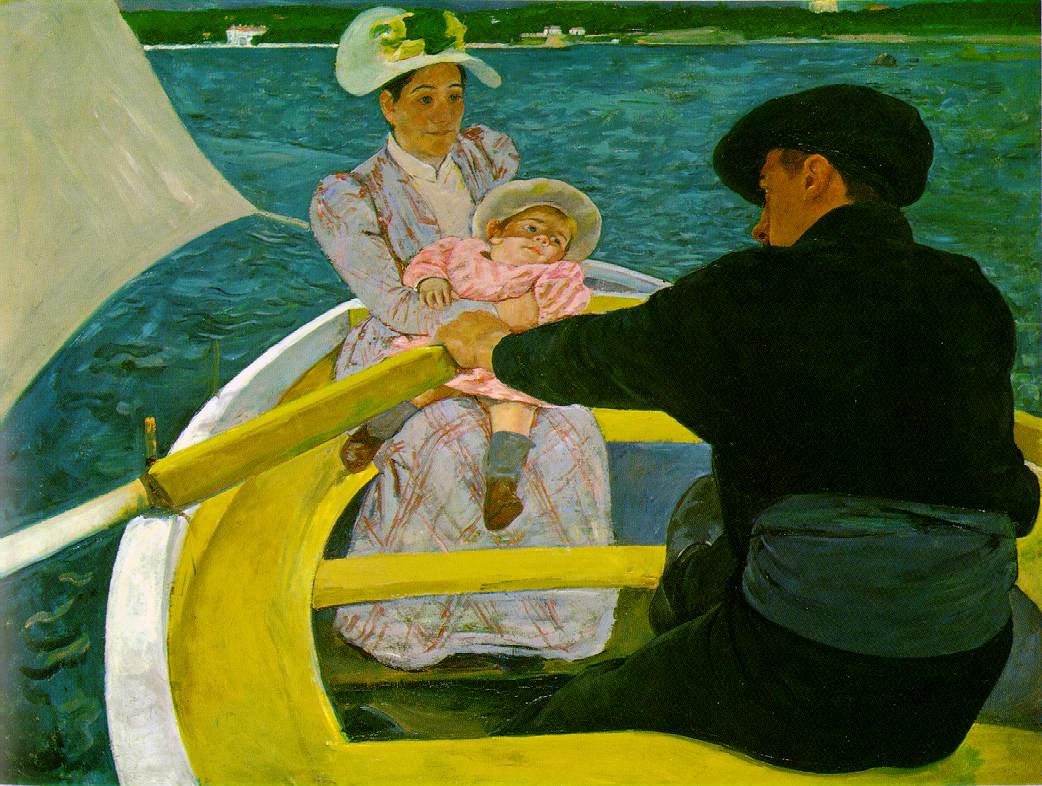
The Boating Party
1893-94 (130 Kb); Oil on canvas, 90.2 x 117.5 cm (35 1/2 x 46 1/4 in); National Gallery of Art, Washington (courtesy of WebMuseum)